Ontario Air Quality Drops to Hazardous Levels: How to Protect Your Indoor Air

Jul 16, 2026

6 Mins
Key Takeaways:
As hazardous wildfire smoke blankets Ontario, staying indoors isn't enough to protect your respiratory health. Learn how to shield your family by optimizing your HVAC settings and upgrading to a medical-grade GeneralAire Whole-Home HEPA and UV system to scrub out 99.97% of toxic PM2.5 smoke particles.
On Wednesday, July 15, 2026, Environment and Climate Change Canada issued urgent air quality warnings across southern Ontario, including Toronto, Ottawa, and Mississauga. Driven by a massive Ontario Wildfire outbreak in northwestern parts of the province, plumes of thick smoke have drifted over 1,000 kilometers south.
By Wednesday morning, Toronto ranked as the most polluted major city in the world, with an AQI exceeding 180. Local officials have activated "orange alerts" as the AQHI Ontario wildfire (Air Quality Health Index) surged into the maximum "very high risk" zone.
The smoke is expected to remain well into Thursday with forecasts of clearing gradually by Friday, July 17th, 2026.
Staying indoors is the primary safety recommendation. However, outdoor pollution quickly penetrates buildings, meaning your indoor air quality wildfire smoke defenses must be properly managed to prevent health complications.
The Health Risks of Wildfire Smoke and Bad Air Quality
Wildfire smoke is a complex mix of toxic gases and fine particulate matter. The most critical health threat comes from particles smaller than 2.5 microns, which require specialized wildfire smoke PM2.5 filtration to capture.
Because PM2.5 particles are microscopic, they easily bypass your respiratory tract's physical defenses, traveling deep into your lungs and entering your bloodstream.
Wildfire Smoke Health Risks in Ontario
-
Mild Symptoms: Eye, nose, and throat irritation, accompanied by headaches and a mild cough.
-
Severe Symptoms: Wheezing, severe coughing, chest pain, and breathing difficulties.
-
High-Risk Groups: Seniors over 65, pregnant individuals, infants, young children, and anyone with pre-existing heart or lung conditions (such as asthma or COPD).
-
Long-Term Impact: Prolonged exposure can trigger cardiovascular events, chronic bronchitis, and severely reduced lung capacity.
How to Protect Your Home from Wildfire Smoke
Your HVAC system acts as your home's primary shield. Knowing how to configure your ventilation system during a smoke event is critical to keeping toxic air out.
| HVAC Component | Recommended Action | Why It Matters |
|---|---|---|
| Air Conditioning | Should I run my AC during wildfire smoke? Yes, keep it running. | Standard AC units cool and recirculate existing indoor air rather than pulling smoky air inside. |
| HVAC Fan Settings | Switch to recirculate HVAC air wildfire settings (Set fan to "ON" rather than "AUTO"). | Constant recirculation forces indoor air through your filtration system continuously, scrubbing out incoming particles. |
| HRV / ERV Systems | Turn off or adjust your HRV ERV wildfire settings to "recirculate only." | These units are built to exchange indoor air with fresh outdoor air, which will pull smoke directly into your home. |
| Furnace Filter | Upgrade to a high-efficiency MERV 13 filter HVAC model. | Standard filters only catch large dust particles; MERV 13 filters are dense enough to trap fine ash and smoke. |
Implementing a Whole-Home HEPA & UV Shield
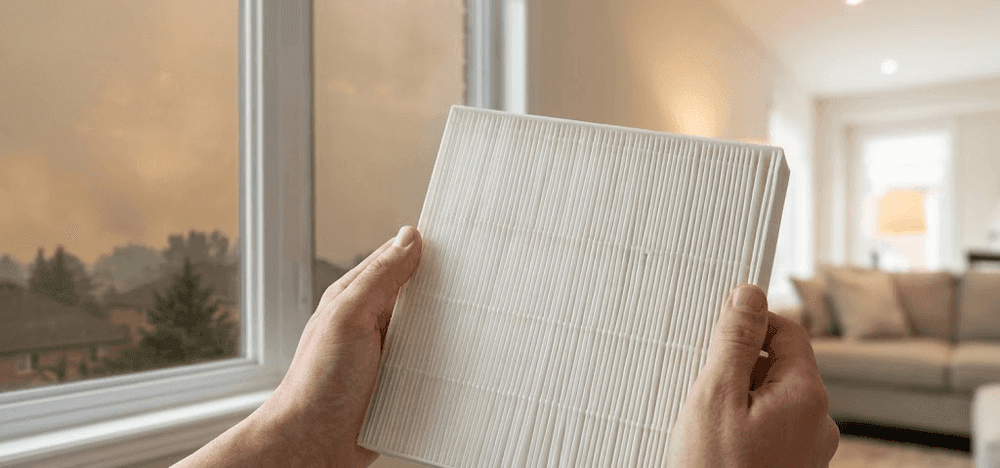
Standard HVAC filters are helpful, but they cannot trap 100% of ultra-fine PM2.5 particles. To fully protect your family, installing a dedicated HEPA filter wildfire smoke system is the recommended solution.
A whole-home HEPA filter upgrade works alongside your current furnace and ductwork. Instead of purifying just a single room with a loud portable unit, it continuously cleans the air in every room of your house.
The GeneralAire Filtration Solution
For medical-grade protection, we recommend integrating the GeneralAire Whole-House HEPA Air Purifier and GeneralAire UV Light system into your home:
-
99.97% Efficiency: The GeneralAire HEPA filter captures microscopic particles down to 0.3 microns, removing smoke, ash, and common allergens.
-
Odour & Gas Removal: Features a carbon-infused pre-filter that actively neutralizes chemical gases and heavy wildfire smoke smells.
-
Pathogen Neutralization: The accompanying GeneralAire UV Light kills airborne viruses, bacteria, and mold spores as they pass through your HVAC ducts.
-
Constant Mitigation: Keeps your home's air safe, fresh, and breathable during seasonal pollution spikes, heavy pollen seasons, and active wildfire events.
Secure Your Indoor Air Quality Today
As wildfire seasons become longer and more intense, waiting for the next high risk air quality warning is a hazard to your family's health. Taking proactive steps to fortify your home’s ventilation is the most reliable way to protect your long-term health.
Explore your indoor air quality options and request a free quote today.
Frequently Asked Questions
1. Should I run my air conditioner or heat pump during an Ontario wildfire smoke advisory?
Yes, absolutely. Running your central air conditioner or heat pump is highly recommended because it allows you to keep all windows and doors closed (preventing outdoor smoke from leaking in) while keeping your home cool. However, you must make sure your thermostat/HVAC system is set to "Recirculate" (or "ON" rather than "AUTO") so it continuously filters the existing indoor air instead of pulling in smoky air from outside.
2. What filter rating is best for removing wildfire smoke and PM2.5 particles?
Standard fiberglass filters cannot capture the microscopic PM2.5 particles found in wildfire smoke. You need a minimum of a MERV 13 pleated filter or HEPA filter to begin trapping smoke particles. For the ultimate level of protection, upgrading to a dedicated whole-home HEPA filtration system is the gold standard, as it is clinically proven to trap 99.97% of airborne particles down to 0.3 microns.
3. Should I turn off my HRV or ERV (ventilation system) during a smoke event?**
**Yes. Heat Recovery Ventilators (HRVs) and Energy Recovery Ventilators (ERVs) are designed to bring fresh, outdoor air into your home. During a heavy wildfire smoke advisory, they will pull that toxic, smoky air directly into your ductwork. You should temporarily turn off or deactivate your HRV/ERV until the outdoor air quality improves.


.70e3bcd1.svg)
.8cbc05bd.svg)
.29c01fed.svg)
.6c51ffe3.svg)